Retargeted shoppers convert up to 70% more often than someone landing on your site cold. Meta still commands the largest share of most ecommerce paid social budgets, but most of the accounts we audit are not structured to capture that advantage. They are still built in ways that quietly cap how far the budget can go.
Before you touch a single campaign setting, get clear on your goals. That clarity dictates how the entire account gets built, not the other way around.
There are plenty of ways to structure a Meta account. This is the funnel-based approach we have refined across client accounts over the last several years. It works.
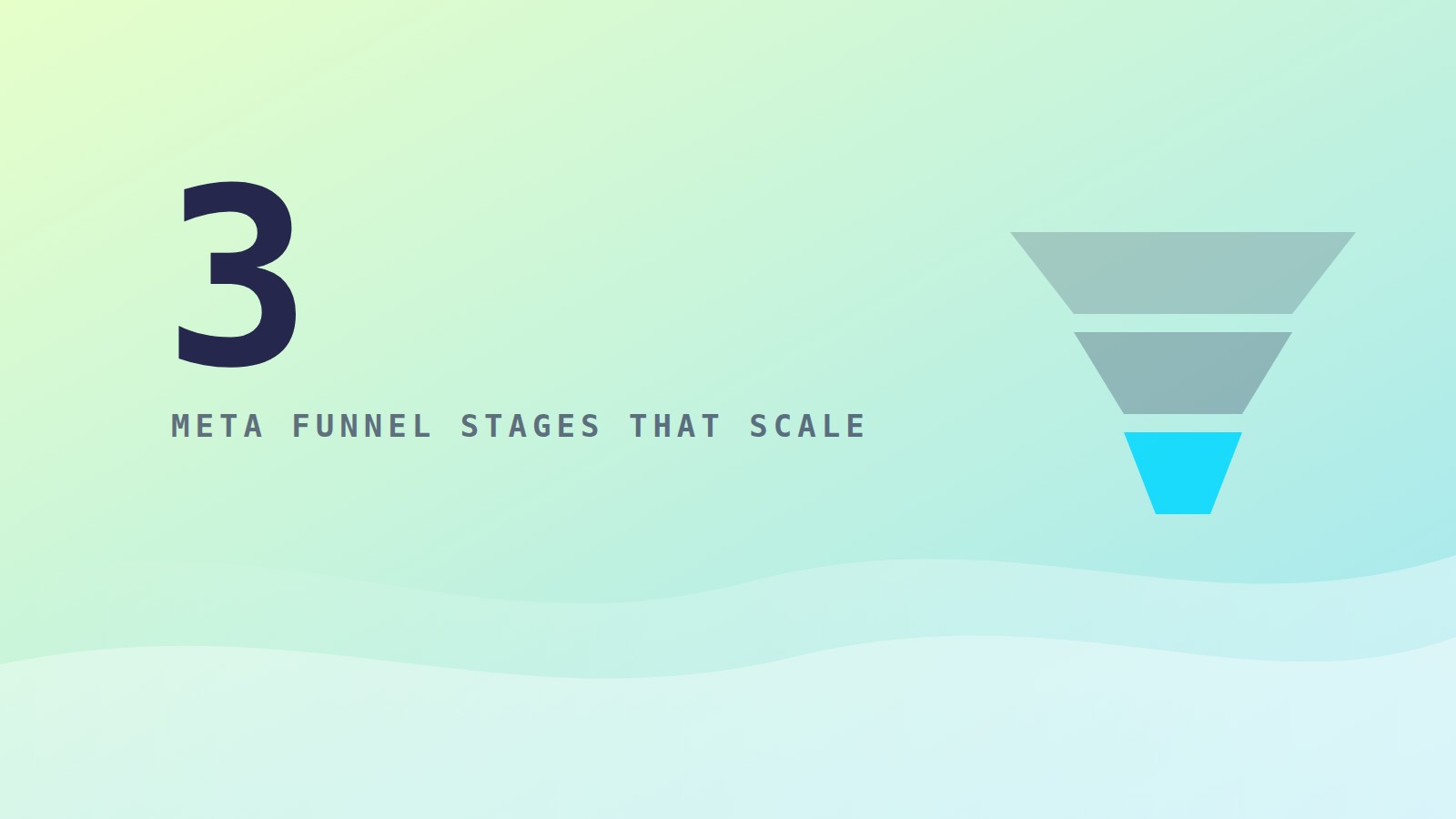
Say you run an ecommerce business that wants to grow. Structuring the account comes back to one thing: the funnel. Understanding its stages is the most important part of the job. We keep it simple, three stages: top-of-funnel, mid-funnel, and bottom-funnel.
Top-of-Funnel
At the top of the funnel, the goal is brand awareness at the lowest possible CPM (cost per 1,000 impressions), without giving up our ability to retarget later. Video View is our default objective here. It keeps costs down and builds something more valuable than reach: a pool of people who actually watched, an audience we can retarget instead of starting cold in the next stage. We are not fans of Landing Page View. Meta casts such a wide net chasing cheap impressions that plenty of the people who click bounce within seconds, and the result is an inflated click-through rate sitting next to a sky-high bounce rate. View Content sees rare use in our accounts, and Add to Cart gets pulled out only occasionally, when an on-site intent signal matters more than video engagement. Whichever objective wins, it becomes Meta’s learning objective, and that is what drives stronger learnings and higher-intent customers down the line.
Mid-Funnel
This is where we educate the people who engaged at the top of the funnel, and show them proof it works. We fill every placement type on purpose:
- Single Image Ads. Great for reviews and social proof, simple and fast to produce.
- Carousel Ads. Also strong for reviews and social proof, and flexible enough to break down a full product story frame by frame.
- Video Ads. UGC or produced, built to explain the benefits and features a single image cannot.
- Dynamic Product Ads. Limited on creative flexibility, but they close: they show people the exact product they already viewed on your site.
Bottom-Funnel
A quick note on definitions: most marketers use “bottom-funnel” to mean converting warm prospects. We do not. That job already belongs to mid-funnel and Advantage+. We reserve bottom-funnel for one thing: retargeting existing customers to grow purchase frequency and lifetime value. It will not do much for a brand that is just starting out, but it becomes one of the highest-leverage stages as the customer base grows. Dynamic product ads that cross-sell or up-sell existing customers are the easiest way to structure it. If you sell anything consumable, anything people need to buy again, this is exactly where you retarget them.
Understanding the funnel and structuring it deliberately is the foundation. Layered on top of it, Meta offers campaign types that perform well once given time to learn.
Advantage+ Shopping Campaign
We were skeptical when we first started testing these campaigns. Early results were mediocre, and it took real time for the learnings to compound. That skepticism has not aged well. We now structure every account with at least one Advantage+ Shopping campaign, focused primarily on top-of-funnel. One important note: Advantage+ is known for flattening the funnel. It does some retargeting inside the same campaign, and depending on how you set the existing-customer budget percentage, it can technically cover both top-of-funnel and mid-funnel at once. It also gives you real creative flexibility: single images, video, carousels, dynamic assets, and promoted posts, all loaded into one campaign.
These campaigns are built for ecommerce, and they perform well across multiple objectives.
AOV Hack
If your catalog spans a wide range of price points, build separate product sets in Meta Commerce Manager, one for your high-value products, one for your low-value products, then run a dynamic product ad against each set. Now you can budget and bid by tier, pushing more spend toward the products that actually lift average order value. No new creative required.
Putting It All Together
However you slice it, the funnel does the heavy lifting. Choose the right objective at each stage, feed Meta’s algorithm clean signals, and the campaigns start compounding on each other: awareness fills mid-funnel, mid-funnel fills bottom-funnel, existing customers keep coming back. Lock this structure in before Q4 hits. Our Q4 paid media planning guide walks through the month-by-month sequencing.
Frequently Asked Questions
What is the best way to structure a Meta ads account?
A funnel-based structure works best: separate top-of-funnel awareness campaigns from mid-funnel education and bottom-funnel retargeting, each with its own objective. This gives Meta’s algorithm cleaner signals to learn from than a single flat campaign trying to do everything at once.
Does Advantage+ replace manual campaign structure?
No. Advantage+ Shopping campaigns work best layered on top of a funnel structure, typically anchored at top-of-funnel, not as a replacement for it. Advantage+ does some retargeting on its own by flattening the funnel, but a dedicated bottom-funnel strategy still matters for lifetime value.
How should Meta ads be structured for brands with a wide price range?
Create separate product sets in Meta Commerce Manager for high- and low-value products, then run a dynamic product ad against each set. This lets you budget and bid differently per tier, pushing more spend toward the products that lift average order value without new creative.
Want a second set of eyes on your account structure? Reach out to our team for an audit and we’ll show you where your growth is being capped.