Key takeaways
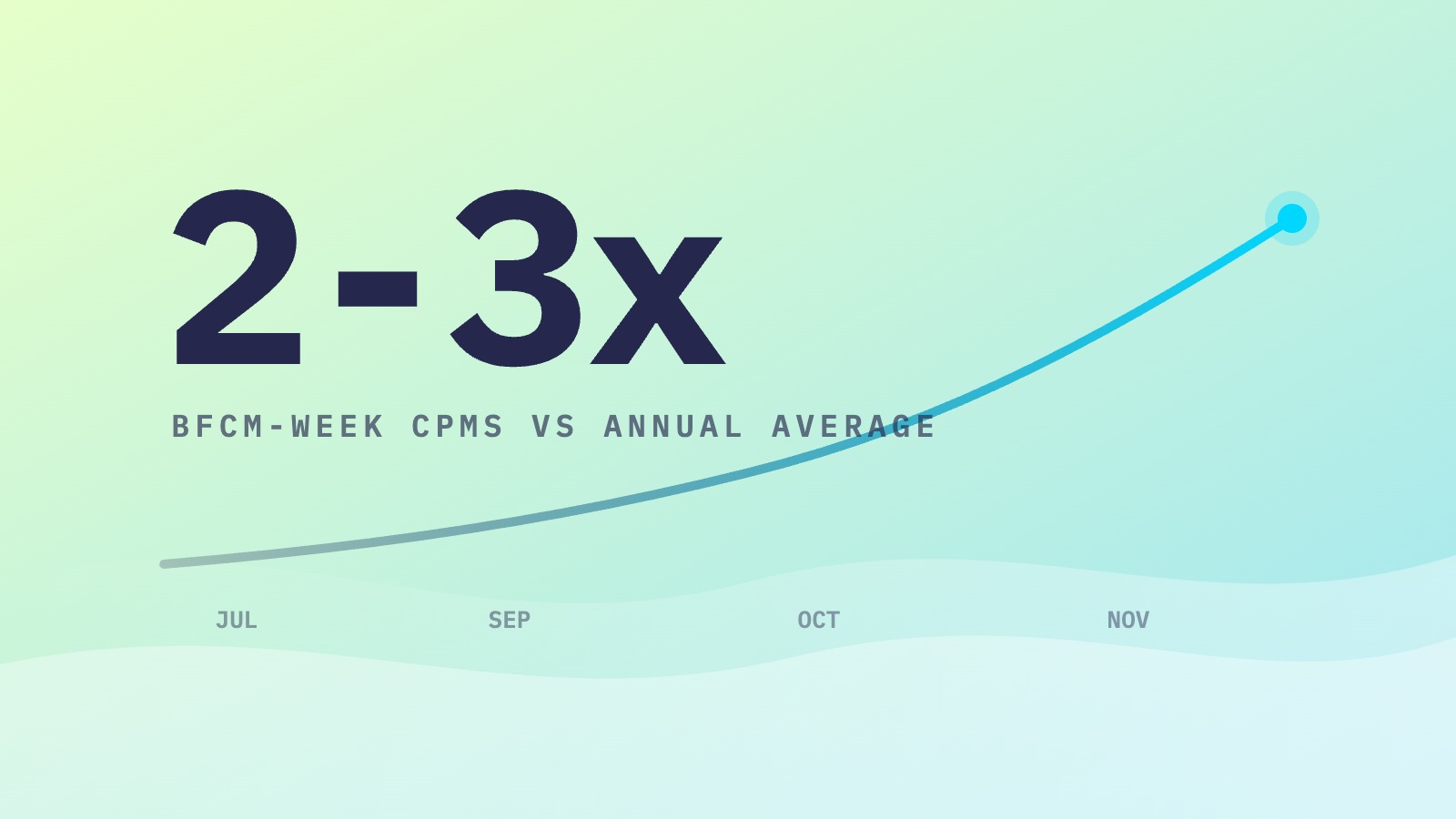
- Q4 CPMs run 25-60% above the annual average, and 2-3x during BFCM week itself.
- Winning brands do the cheap work early: audiences in September, creative tests in October.
- Model November efficiency at 30-50% worse than your trailing 90-day average, then work backward.
If you are reading this in July and have not started planning your Black Friday and Cyber Monday paid media strategy, you are not behind yet. But you are close.
Here is the reality of Q4 advertising in 2026: CPMs (cost per 1,000 impressions) run 25-60% above the annual average from November through mid-December, and during BFCM week itself, they can hit two to three times the annual average. Meta CPMs hit an all-time high of nearly $23 in Q4 of last year, and every indication points to this year being more expensive, not less.
That means every dollar you spend during the sale window works harder against you than it did in June. The brands that win Q4 are not the ones that outspend everyone in November. They are the ones that did the cheap work early, so their November dollars land on warm audiences with proven creative.
We have managed enough Q4 cycles to know exactly where the calendar breaks down. This is the month-by-month framework we use with our clients.
Why Waiting Until September Costs You Real Money
We said it in our Black Friday planning guide and it is worth repeating: if you are just starting to think about your BFCM plan in September, you have arguably already waited too long.
There are three compounding costs of a late start:
- You pay peak prices to build audiences. Retargeting pools do not appear out of thin air. If you have not filled the top of your funnel by October, you will be prospecting cold audiences in November at 2-3x CPMs. That is the most expensive possible way to find new customers.
- You test creative during the most expensive weeks of the year. Creative testing requires spend and time. Testing in November means burning premium impressions on ads that might not work.
- Your account has no learnings to lean on. Meta’s Advantage+ campaigns and Google’s Performance Max both perform dramatically better with clean, recent conversion data. An account that scaled smoothly through September and October enters November with momentum. An account that sat quiet does not.
The July-to-December Q4 Paid Media Timeline
July: Strategy and Goals
This is the planning month. Before a single dollar of Q4 budget is deployed, we want answers to the questions that shape everything downstream: What is the revenue goal for the sale? What is the margin available for promotion? Are there inventory constraints or a product launch we need to build around? What did competitors do last year?
From there, build your complete Q4 budget. Not just media spend, but creative production, web development, agency or contractor fees, and your team’s time. Marketers consistently forget that planning time equates to dollars.
August: Creative Production
Creative is the single biggest performance lever in paid social, and it has the longest lead time. August is when production happens: UGC (user generated content) briefs go out, product photography gets shot, and your BFCM offer messaging gets locked so design work can start.
Produce more variations than you think you need. Q4 fatigue is real, and ads that crushed it in early November can die by Cyber Monday. We like entering Q4 with at least 3-4 distinct creative concepts per funnel stage, each with multiple formats.
September: Audience Building Begins
September is when we shift media dollars toward top-of-funnel campaigns designed to fill retargeting pools at pre-Q4 prices. Video views, site traffic with real intent objectives like View Content and Add to Cart, and aggressive email and SMS list growth all matter here.
The email opt-in point is worth underlining. Every subscriber you capture in September is someone you can reach in November for free, while your competitors pay record CPMs to reach the same person.
October: Testing and Warm-Up
October is the dress rehearsal. Launch your creative tests with enough budget to reach statistical signal. Kill the losers, scale the winners, and let your campaigns accumulate conversion data so platform algorithms enter November fully calibrated.
This is also when top-performing brands start momentum campaigns, teasing the sale, running early-access signups, and building anticipation with their warmest audiences.
November: Execution
If July through October went right, November is execution, not invention. Early November is for early-access offers to your list and warm audiences. BFCM week is for scaling what you already know works. Launching your BFCM campaigns the week of Thanksgiving is too late. The momentum needs to already exist.
December: Capture and Calibrate
Post-BFCM, attention shifts to gift-buying deadlines and then to measurement. December is the ideal time to run incrementality tests and calibrate your measurement models while Q4 signal is fresh. Those learnings become the foundation of next year’s plan.
Budgeting for 2-3x CPMs Without Panic
30-50%Model your November efficiency at 30-50% worse than your trailing 90-day average, then work backward.
If your typical CPA (cost per acquisition) is $40, plan the sale math at $52-60. If the promotion still pencils at those numbers, you have a durable plan. If it only works at June efficiency, you have a spreadsheet fantasy.
This is also why the September-October audience building matters so much. Warm retargeting audiences routinely convert at a fraction of cold-traffic CPAs, which is what pulls your blended numbers back toward target even while auction prices spike.
The Questions We Ask Every Client in July
- What is the single most important outcome of this Q4? Revenue, new customers, or inventory movement?
- How much margin can the promotion give up and still be profitable after media costs?
- What creative assets exist today, and what has to be produced?
- How large are your current retargeting pools and email/SMS lists relative to your revenue goal?
- What does the post-purchase experience look like for a surge of new customers?
If you can answer all five with confidence, your plan is in good shape. If two or more produce a shrug, that is exactly the gap July exists to close.
Start Now, Thank Yourself in November
Q4 rewards preparation with cheaper audiences, proven creative, and calibrated campaigns. It punishes procrastination with peak CPMs and guesswork. The math is not subtle, and the calendar is not negotiable.
Frequently Asked Questions
When should I start planning Black Friday ads?
Planning should start in July, with creative production in August, audience building in September, and testing in October. Brands that launch BFCM campaigns the week of Thanksgiving consistently pay peak CPMs for cold audiences and untested creative.
How much do CPMs increase during Q4?
CPMs typically run 25-60% above the annual average from November through mid-December. During BFCM week itself, CPMs can reach two to three times the annual average, with Meta CPMs hitting record highs each recent Q4.
How much should I increase my ad budget for BFCM?
Rather than starting from a spend number, model your expected CPA at 30-50% worse than your trailing 90-day average and work backward from your revenue and margin goals. If the promotion is profitable at those costs, size the budget to your inventory and list capacity. The earlier your audience building starts, the less extra budget the sale window requires.