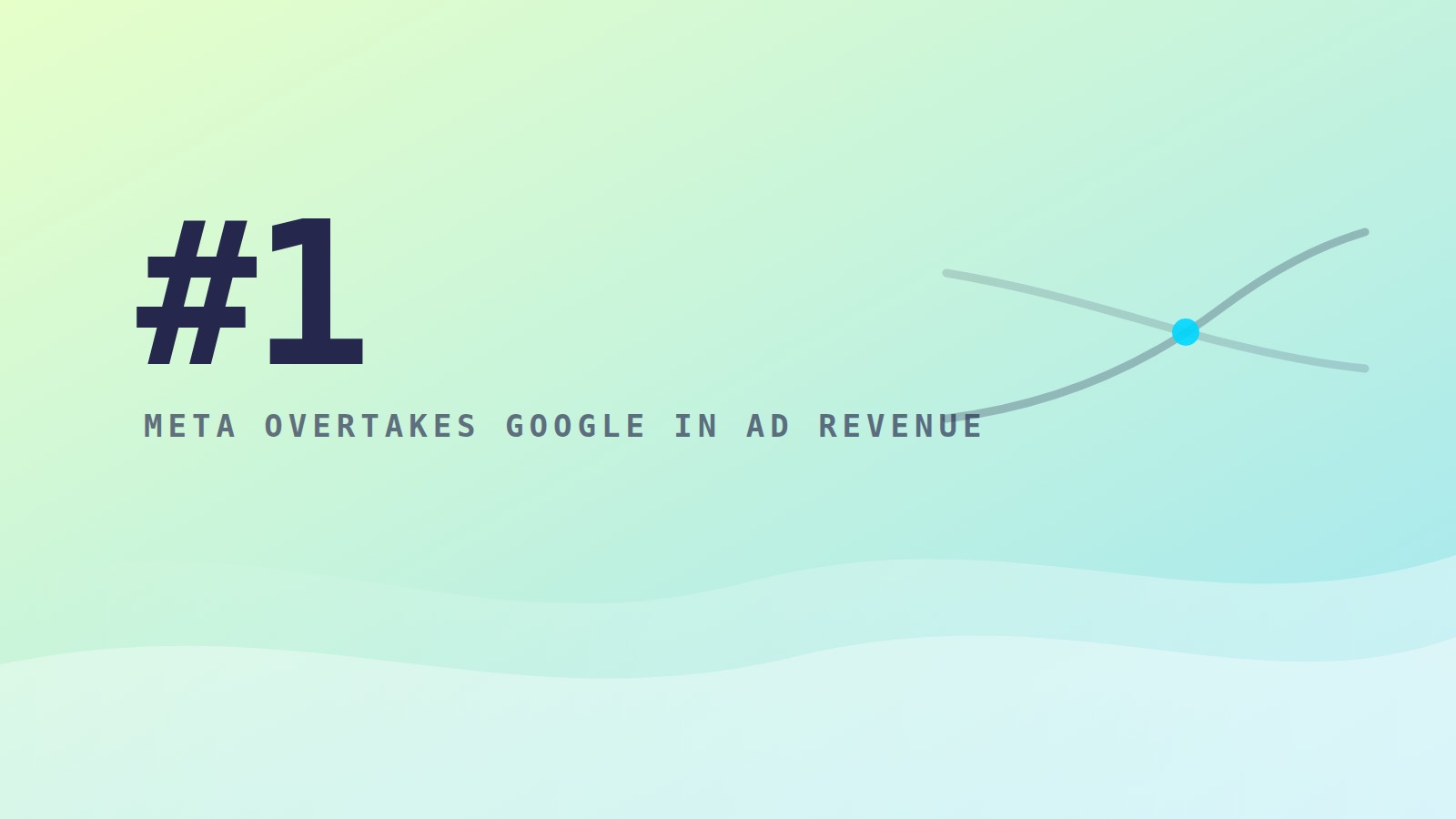
For the first time in roughly two decades, Google is not the biggest advertising company on earth. Meta is projected to generate $243.5 billion in global ad revenue in 2026, edging past Google’s $239.5 billion, according to EMARKETER’s forecast.
On one level, this is trivia. Your customers do not care which trillion-dollar company collects more ad dollars. But the forces behind the crossover are exactly the forces reshaping where your next media dollar should go: the erosion of traditional search behavior, the rise of AI answers, and the growing dominance of creative-driven, algorithmically-delivered social advertising.
This post is not about picking a side. It is about reading the shift correctly and rebalancing your media mix with intent rather than inertia.
Why the Crossover Happened
Three trends explain most of it.
Search behavior is fragmenting. About 39% of the US population uses generative AI in 2026, according to EMARKETER, and a growing share of product discovery queries start in AI interfaces like ChatGPT and Perplexity rather than a Google search box. Google still prints money, but the growth engine that made it untouchable, ever-expanding search volume, is no longer a given.
Meta solved its targeting crisis with AI. After iOS privacy changes kneecapped its targeting in 2021, Meta rebuilt delivery around machine learning at enormous scale. Advantage+ now has an annual revenue run rate of more than $75 billion, per Meta’s Q2 2026 earnings, and performance has recovered to the point where Meta is many DTC brands’ most efficient growth channel again. Our own Meta account structure guide walks through how we build around that shift.
Commerce keeps shifting to discovery. More purchases begin with a product a consumer did not know existed, surfaced in a feed, than with a deliberate search. That structurally favors discovery platforms.
What This Means for Your Media Mix (and What It Does Not)
The wrong takeaway: “Meta beat Google, shift budget to Meta.” Your media mix should follow your incremental returns, not industry headlines. A brand whose category is driven by high-intent problem-aware search may still find Google spend irreplaceable. A brand built on impulse and visual appeal may already be under-invested in Meta.
The right takeaway is subtler: the assumptions your current budget allocation was built on are probably stale. Most brands’ channel splits are archaeology, layers of decisions made under conditions that no longer exist. The crossover is a good excuse to re-derive your mix from current data.
A Framework for Rebalancing
1. Map Your Demand Capture vs. Demand Creation
Split your spend into two jobs. Demand capture harvests existing intent: branded search, shopping ads against category queries, retargeting. Demand creation builds intent that did not exist: prospecting on Meta and TikTok, YouTube, influencer whitelisting.
| Demand capture | Demand creation | |
|---|---|---|
| The job | Harvests intent that already exists | Builds intent that did not exist |
| Typical line items | Branded search, Shopping on category queries, retargeting | Prospecting on Meta and TikTok, YouTube, creator whitelisting |
| How it looks in attribution | Usually flattering | Usually understated |
| Ceiling | Capped by how much demand already exists | Grows the pool that capture draws from |
| Warning sign | Growth plateaus while ROAS looks healthy | Spend rises with no lift in branded search or direct traffic |
Most accounts we audit are overweight demand capture, because capture always looks better in attribution. But capture has a ceiling, and it is set by how much demand exists. If growth has plateaued while ROAS looks healthy, you are usually at that ceiling.
2. Measure Each Channel’s True Incremental Return
Platform-reported ROAS will not settle a budget debate between Google and Meta, because both platforms overclaim. Geo holdout tests on your two or three biggest line items will. We cover the full methodology in our incrementality testing guide; the point here is that rebalancing without lift data is just moving money between stories. We have seen this most starkly with Performance Max, where branded search cannibalization alone can inflate reported ROAS.
3. Account for the AI Search Wildcard
Some share of the search traffic you have historically captured is migrating into AI answers, where today there is less ad inventory. Two practical responses: first, watch your branded and non-branded search volumes for erosion rather than assuming last year’s baseline. Second, invest in the content and brand visibility work that gets you cited and recommended inside AI answers. For purchase queries, one study of 1,851 AI citations found just 2.8% pointed to the brand’s own page.
4. Rebalance in Steps, Not Leaps
Media mixes should move like portfolios, not like pendulums. Shift 10-15% of budget per quarter toward the channels your lift data favors, hold your measurement constant, and re-read the results. Big-bang reallocations destroy the very baselines you need to learn from. Time any bigger shift around your Q4 paid media planning cycle, when budgets are already in motion and stakeholders expect a rationale.
The Channels Beyond the Big Two
The Meta-Google framing also hides the fastest-moving parts of the market. Retail media is approaching $70 billion in US spend (EMARKETER), and for brands selling on Amazon it is effectively mandatory. TikTok remains a creative-testing engine and a genuine acquisition channel for the right demographics. YouTube, now stocked with AI-generated video tooling, is the most underpriced awareness inventory for many DTC brands.
A 2027-ready mix is not two platforms. It is a portfolio with a deliberate capture-creation balance, sized by measured lift.
Strategy Beats Loyalty
Google being dethroned after twenty years is a reminder that no channel deserves loyalty, only measurement. The brands that grow through this shift will be the ones that treat their media mix as a living decision, revisited quarterly with real lift data, rather than a settled question.
Frequently Asked Questions
Should I move ad budget from Google to Meta?
Not based on headlines. Budget should follow your measured incremental returns, not industry revenue rankings. Run geo holdout tests on your largest channels and shift 10-15% of budget per quarter toward whichever channels show the strongest true lift for your brand.
What is the difference between demand capture and demand creation?
Demand capture harvests intent that already exists: branded search, shopping ads, and retargeting. Demand creation builds new intent through prospecting on social, video, and influencer channels. Most accounts are overweight capture because it looks better in attribution, but capture is capped by existing demand.
How is AI search changing paid media planning?
A growing share of product discovery now starts in AI interfaces rather than search engines, which erodes the search volume advertisers have historically captured. Brands should monitor search volume trends rather than assuming last year’s baseline, and invest in the third-party content and reviews that AI assistants cite when recommending products.
Want a second set of eyes on your channel allocation? Book a strategy call with the Strat88 team and we will pressure-test your media mix against your actual incremental returns.