If your Google Ads account ran Search campaigns with the campaign-level broad match setting or automatically created assets, Google moved them to AI Max for Search in September, opted in or not. Before you decide whether AI Max is working, check three things: which features it switched on, whether it is buying clicks your brand campaign or Performance Max already had, and whether it moves MER (marketing efficiency ratio) rather than the conversions Google reports inside the campaign.
Google’s headline numbers won’t answer that for you, because they come from non-retail advertisers. Here’s what changed, what to check, and how to test AI Max against revenue the business actually kept.
Key takeaways
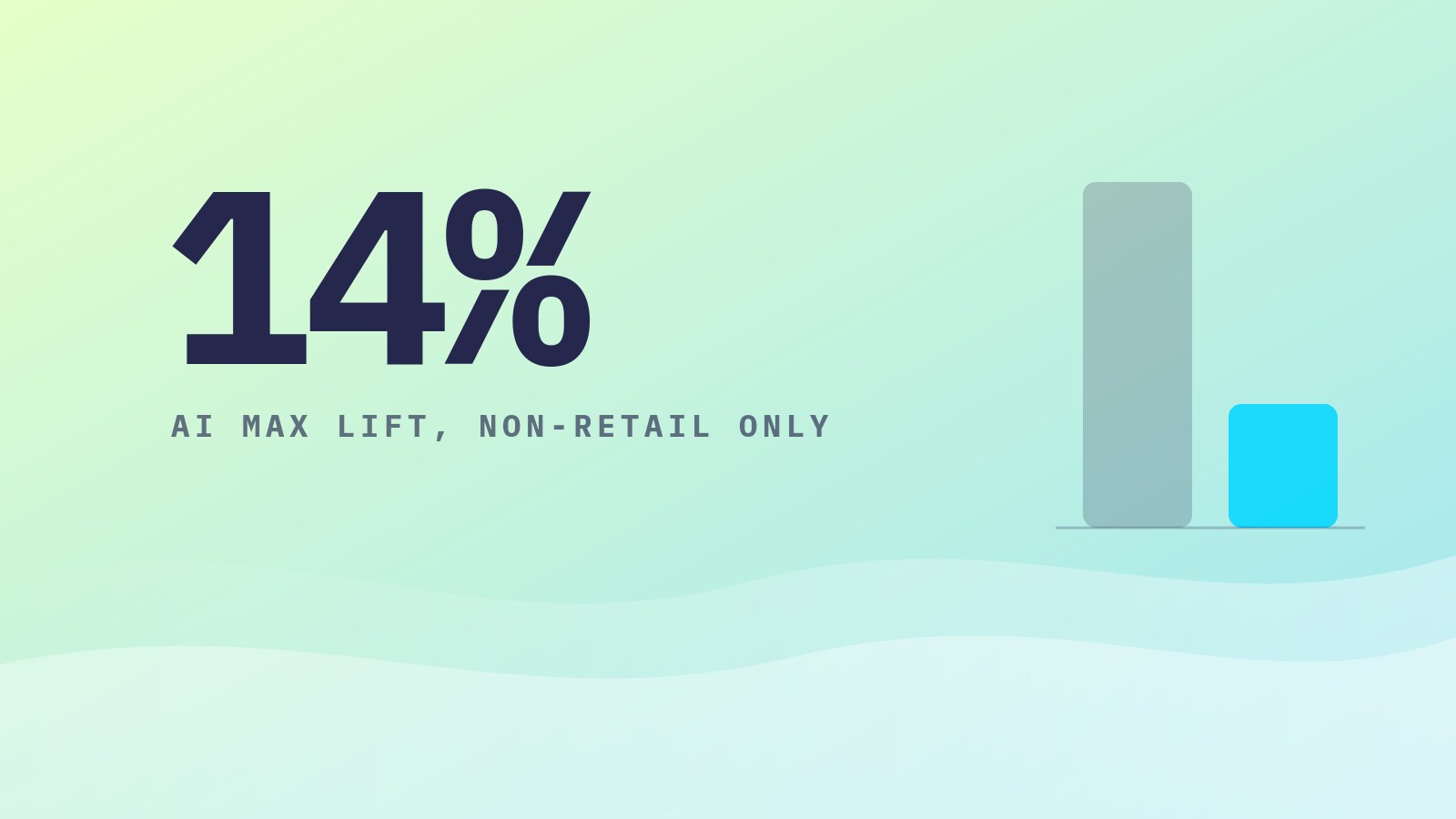
- Google’s published AI Max for Search lifts, 14% and 7% more conversions or conversion value at a similar CPA or ROAS, are measured on non-retail advertisers. Its retail figure, for AI Max for Shopping, is 5%.
- The September auto-upgrade turned on search term matching by default, plus text customization for campaigns that used automatically created assets. Dynamic Search Ads follow in February 2027.
- Judge AI Max on incremental revenue and MER with branded queries separated out, not on the conversions Google credits to the campaign.
What AI Max for Search Changed in September
AI Max for Search is a set of AI features switched on inside a standard Search campaign. It is not a new campaign type. Google’s help documentation lists three features:
- Search term matching shows your ads on queries beyond your keywords, using broad match plus the content of your landing pages and assets.
- Text customization writes headlines and descriptions from your existing ads, your site and generative AI.
- Final URL expansion sends the click to whichever page on your site Google predicts fits the query best, not necessarily the one you set.
Google stopped allowing new campaigns with campaign-level broad match or legacy automatically created assets on August 3, then migrated the existing ones in place through September, according to Search Engine Land’s timeline. Per Google’s announcement, campaigns that used automatically created assets came over with search term matching and text customization on, and campaigns with the broad match setting came over with search term matching on. Dynamic Search Ads (DSA) are next. They auto-migrate in February 2027, and Google says upgraded DSA campaigns get all three features.
One mechanical change is easy to miss. The old broad match setting treated broad keywords like exact match for prioritization. AI Max doesn’t. To get that back, Google says to add exact match copies of those keywords.
Start by filtering your campaigns for AI Max and writing down which of the three features are on in each one. That’s your baseline for everything below.
Read Google’s AI Max for Search Numbers Before You Trust Them
Google publishes three lift figures for AI Max. The footnotes matter more than the headlines.
- 14% more conversions or conversion value at a similar CPA or ROAS for advertisers who activate AI Max in Search. Google internal data, 2025, non-retail advertisers.
- 7% more for Search campaigns using all three features versus search term matching alone. Google internal data, 2026, non-retail advertisers.
- 5% more for AI Max for Shopping, which is still in beta. Google internal data, 2026, retail advertisers.
Two things follow. None of these figures covers a retail brand running AI Max on Search, and the one retail figure Google does publish is about a third of the headline. "At a similar CPA or ROAS" (cost per acquisition or return on ad spend, as Google Ads reports them) means the lift was measured inside Google Ads, so it counts conversions Google attributes to itself, not sales that would not have happened anyway.
None of that means AI Max doesn’t work. It means the number to beat is your own, measured your way. We run accounts on MER, total revenue divided by total marketing spend, because it doesn’t care which platform claims the sale. If AI Max is adding real demand, MER and new customer revenue move. If it is relabeling demand you already had, only the campaign report moves.
Where AI Max for Search Overlaps Brand Search and Performance Max
Search term matching reaches queries your keywords didn’t cover, and unless something stops it, that includes your own brand name.
In a large field experiment at eBay, published by the National Bureau of Economic Research, researchers found brand keyword ads had no measurable short-term benefit, and that most paid search spend reached frequent buyers who would have purchased anyway. A campaign that quietly picks up branded queries will report a strong return the business never sees.
Performance Max (PMax) is the second overlap. Google’s AI Max FAQ says that when a query could match both AI Max and Performance Max, the one with the higher Ad Rank serves, the same way broad match works. A Search keyword that exactly matches the query still takes priority over PMax. So AI Max and PMax can trade the same queries, and each reports the sales it won. We covered the PMax side of this in how to stop PMax cannibalizing branded search.
The controls exist. Brand exclusions sit at the campaign level in AI Max and keep a campaign off your brand queries. Brand inclusions fence a dedicated brand campaign to brand queries only. In May, Search Engine Land reported Google testing a "Branded searches" setting that can show ads only on unbranded searches. It was an early sighting, not a confirmed rollout. Google also warns that overusing brand settings can limit conversions, so apply them to the campaigns that need them.
To size the overlap, open the search terms report, filter the match type to AI Max, sort by cost, and add up how much of that spend went to queries containing your brand name.
Five AI Max for Search Settings to Check This Week
- Feature status per campaign. Confirm which of search term matching, text customization and final URL expansion are on, and that each one is on because you chose it.
- Brand fencing. Brand exclusions on every non-brand campaign running AI Max, brand inclusions on the brand campaign. Your existing negative keywords still apply.
- URL exclusions. Exclude pages that should never be landing pages: blog posts, careers, wholesale, policy pages and collections that are mostly out of stock. The landing pages report has a "Selected by" column that shows which URLs AI Max chose.
- Generated copy. Text customization assets show "Google AI" in the "Added by" column of the asset report. Check them for pricing, promo terms and claims. Pinned assets aren’t respected when text customization and final URL expansion are both on.
- Bidding and tracking. Search term matching doesn’t work on Manual CPC, so AI Max campaigns need conversion-based bidding. Before turning on final URL expansion, confirm your tracking template works on pages you didn’t specify. Google’s AI Max for Shopping documentation warns that incompatible setups can send clicks to 404 pages.
How to Test AI Max for Search for Incremental Revenue
Incrementality means the sales that happened because of the ads. Google’s built-in AI Max experiment splits one Search campaign into an arm with AI Max off and an arm with it on. Two catches. The quick setup isn’t available for campaigns that already have text customization on, use a portfolio bid strategy or shared budget, or have another experiment running, so a lot of auto-upgraded campaigns need a custom experiment instead. And the experiment summary reports Google’s own conversions.
Run the test, then read it like this:
- Strip branded queries out of both arms before you compare. Otherwise the arm that picked up more brand traffic wins by default.
- Compare new customer revenue and contribution margin where you can, not total conversions.
- Check the whole Google account, not just the test campaign. If AI Max gained what PMax and the brand campaign lost, total Google spend went up and nothing was added.
- Run it long enough to get past order size noise. In one account we manage, a low-volume branded campaign reported a return of 1.07x one period and 5.91x the next with nothing changed inside it, because a few large orders came through different channels. Our rule of thumb: under about 50 conversions a period, the ratio is measuring your biggest buyer, not your campaign.
For accounts big enough to hold out a region, a geo holdout gives a cleaner read than any in-platform experiment. Our guide to incrementality testing walks through how to set one up.
When to Keep AI Max for Search On, and When to Turn Parts Off
AI Max isn’t all or nothing. Keep search term matching on where the campaign uses conversion-based bidding, has enough volume to learn, is fenced off your brand, and the test shows account-level revenue going up. Turn it off at the ad group level where it is mostly buying your brand or queries you can’t fulfill.
Turn text customization off where copy carries regulated claims, exact pricing or promo terms that change often. A headline you didn’t write still ships under your name.
Keep final URL expansion off if your site has a lot of thin, seasonal or out-of-stock pages, at least until URL exclusions cover them.
Plan the DSA move on your own schedule before February 2027 rather than letting the auto-migration choose your settings. And remember that AI Max changes how Google spends your Search budget, not how much of your budget Google should get. That is a media mix decision, made on incremental return across channels, and it’s the call our paid media team works through with clients every quarter.
Frequently Asked Questions
What is AI Max for Search in Google Ads?
AI Max for Search is a set of features inside a standard Google Search campaign: search term matching, text customization and final URL expansion. They widen which queries your ads show on, write ad copy from your site and assets, and choose landing pages. It is not a separate campaign type, and each feature can be turned on or off.
Did Google automatically turn on AI Max in my account?
If your Search campaigns used the campaign-level broad match setting or automatically created assets, yes. Google migrated those campaigns to AI Max through September 2026, with search term matching on by default and text customization on for automatically created asset campaigns. Dynamic Search Ads campaigns are scheduled to migrate automatically in February 2027.
Does AI Max for Search cannibalize branded search?
It can. Search term matching can reach queries containing your brand name unless the campaign has brand exclusions, and research on brand keyword ads has found little short-term incremental benefit. Check the search terms report filtered to AI Max for brand queries, add brand exclusions to non-brand campaigns, and keep your brand campaign fenced with brand inclusions.
Should ecommerce brands turn off AI Max?
Not by default. Test it first. Run an experiment, remove branded queries from both arms, and compare new customer revenue, contribution margin and total Google spend, not in-platform conversions. Keep the features that add revenue the business keeps. Turn off text customization where pricing or claims must be exact, and final URL expansion where the site has weak landing pages.
Not sure what the September upgrade changed in your account, or whether AI Max is adding revenue or just claiming it? Reach out to one of our experts and we’ll walk through it with you.
Sources
- Google Ads Help, "About AI Max for Search campaigns," accessed October 2026
- Google, The Keyword, "Google’s Dynamic Search Ads are upgrading to AI Max," 2026
- Google Ads Help, "About AI Max for Shopping campaigns (beta)," accessed October 2026
- Google Ads Help, "How AI Max for Search campaigns works," accessed October 2026
- Google Ads Help, "Frequently asked questions about AI Max for Search campaigns," accessed October 2026
- Google Ads Help, "About reporting in AI Max for Search campaigns," accessed October 2026
- Google Ads Help, "About AI Max experiments," accessed October 2026
- Google Ads Help, "How Performance Max interacts with other campaigns in your account," accessed October 2026
- Google Ads Help, "How to steer branded traffic," accessed October 2026
- Search Engine Land, "Google sets AI Max migration timeline for Search campaigns," 2026
- Search Engine Land, "Google appears to be testing new branded search controls in AI Max campaigns," 2026
- National Bureau of Economic Research, Blake, Nosko and Tadelis, "Consumer Heterogeneity and Paid Search Effectiveness: A Large Scale Field Experiment," 2014
- Strat88 account data, shared as ratios only