ChatGPT ads for ecommerce are worth a small, capped test, not a budget shift. The first independent data shows a paid ChatGPT visit earning about a third of what a paid Google Search visit earns, so a test has to prove incremental revenue before the channel gets a real line in your plan.
OpenAI opened self-serve buying and click bidding in May, has since added product feed ads and conversion bidding, and switched on AI rewriting of ads by default in late October. Below: the early numbers, what to change before you spend, and how to judge a test on MER (marketing efficiency ratio, total revenue divided by total marketing spend).
Key takeaways
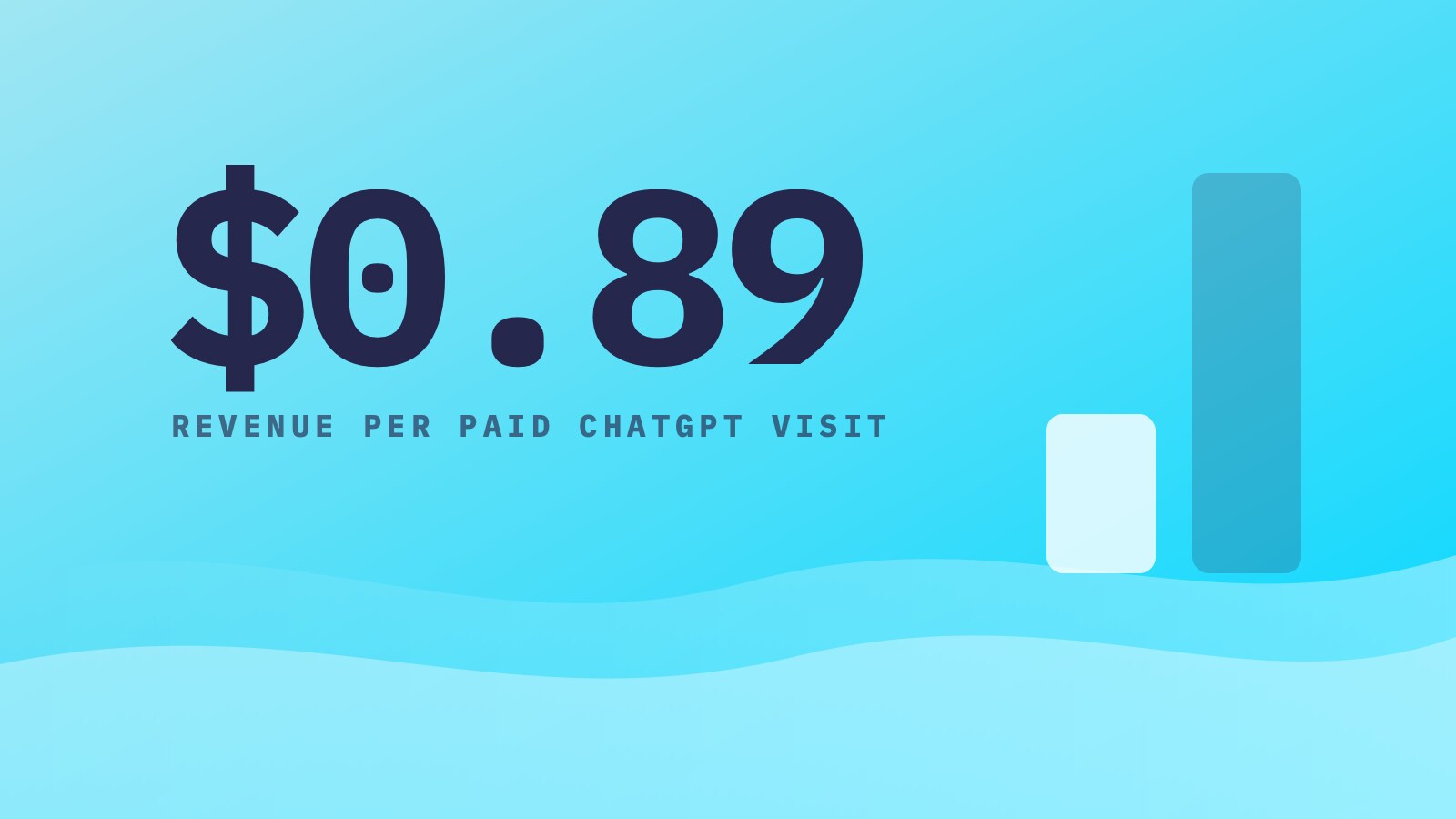
- In US traffic across 102 advertiser sites, a paid ChatGPT visit generated $0.89 in revenue per session against $2.45 for a paid Google Search visit, according to an October 2026 working paper. It’s one observational study, but the gap is large.
- OpenAI recommends starting click campaigns at a $3 to $5 maximum bid. Set your own ceiling from your conversion rate and contribution per order instead.
- Turn off creative enhancements before launch, start the test in January after the holiday peak, and judge it on MER and new customer CAC (customer acquisition cost) against a holdout, not on platform-reported conversions.
What ChatGPT Ads Are and Who Sees Them
ChatGPT ads are sponsored placements that appear below ChatGPT’s answers, labeled and kept separate from the response. Per OpenAI’s Help Center, the system picks an ad using signals that include the conversation, the ad itself and your context hints. A context hint is a short description of the conversations where your product fits. It guides matching, but it isn’t an exact-match keyword.
The audience is narrower than ChatGPT’s headline number. OpenAI began testing ads on February 9, 2026 with logged-in adults on the Free and Go plans. Plus, Pro and Business users don’t see ads, and Free users can opt out in exchange for fewer daily messages.
The scale is real, though. OpenAI said ChatGPT Ads reached a $1 billion annualized revenue run rate in less than 200 days, and on November 10 it put ChatGPT’s weekly users at 1.2 billion.
For ecommerce, the format that matters is the product feed campaign. You upload a catalog and Ads Manager builds ads from your product images, titles, prices and ratings. OpenAI says feed ads have been among the strongest performers in its program. Feed items expire after two weeks, so connect a hosted URL or a scheduled upload rather than a one-time file.
What the Early Data Says About ChatGPT Ads for Ecommerce
OpenAI’s numbers and the independent numbers disagree, so read both.
OpenAI’s own examples are positive: an ecommerce advertiser with a 3x return on ad spend across 28 days, and a technology partner reporting that more than 80% of ad-driven ChatGPT traffic came from new customers. Both are platform-reported and chosen by OpenAI. The 3x is platform ROAS (return on ad spend), which measures credit, not growth.
The independent evidence is weaker. Maximilian Kaiser and Christian Schulze’s working paper on ChatGPT’s ad rollout measured 1,898 online shops from outside the platform. In US traffic, a paid ChatGPT visit generated $0.89 in revenue per session against $2.45 for a paid Google Search visit, and converted at 0.37% against 1.17%. Of 87 advertisers using both channels, 97% earned less revenue per ChatGPT visit, Search Engine Land reported.
Brand-side reports land in the middle. Of 30 enterprise brands that shared July to September results with Adthena, a search intelligence platform, 52% said spend was outrunning return, 22% reported mixed results and 26% were matching or beating Google, per Adthena’s October 2026 summary.
Two caveats cut in ChatGPT’s favor. The paper counts revenue on the visit, so it can miss a shopper who clicks today and buys next week through search. And one supplement brand’s geo holdout, published by measurement vendor WorkMagic, found 2.3x more incremental orders than click attribution showed, plus a lift in its Amazon sales. That’s the case for a test, not for pulling budget from channels you’ve already proven.
What ChatGPT Ads Cost, and the Bid Your Margin Allows
ChatGPT ads cost what you bid. You pay per 1,000 impressions or per valid click, even on campaigns optimized for conversions, so you never pay per sale, per OpenAI’s campaign guide. The US minimum is $25 a day per campaign, and spend on any one day can reach twice the daily budget.
For click campaigns, OpenAI recommends a starting maximum bid of $3 to $5. The working paper estimates that at paid search’s rate of return, a paid ChatGPT click is worth about $0.26, and that the largest publicly known account paid $1.72 a click.
Run the arithmetic before you accept any suggested bid. Your break-even cost per click (CPC) is your conversion rate times your contribution per order, meaning what an order is worth after product cost, shipping, fees and returns, before marketing. At a $3 click and the 0.37% conversion rate the study measured, each order costs about $811 in media. At $5, it’s about $1,351. Your numbers will differ, so use yours.
We covered how to find that contribution number in our guide to an ecommerce marketing budget built from contribution margin.
Write the break-even CPC down and set your bid cap below it, even if Ads Manager says the bid may limit delivery. Low delivery at a profitable price is a finding, not a failure.
Settings to Change Before Your First ChatGPT Ads Campaign
Several ChatGPT ads defaults work against a clean test. Change them before you spend.
- Turn off creative enhancements. OpenAI told self-serve advertisers it would switch them on for new and existing campaigns on October 30, 2026, Search Engine Land reported. When on, OpenAI can rewrite headlines, translate ad text, resize images and send the click to a different page on your site, with no preview of every variation. Switch it off in account settings, then check each campaign, since campaign settings override the account default. Meta does the same with Advantage+ creative enhancements.
- Install the OpenAI Pixel and the Conversions API together. Send the same event ID through both so OpenAI can deduplicate, and keep OpenAI’s click reference intact through redirects, per its conversion measurement guide. It’s the same first-party data discipline Meta and Google reward.
- Tag every ad URL with UTM parameters. Without them, you can’t reliably separate paid ChatGPT sessions from organic ChatGPT referrals in your analytics.
- Keep each context hint to one idea. Adthena found a broad hint matched its own ads to off-topic prompts, and a tight one fixed it.
- Filter the feed to a test set. Feed items are ads-eligible by default. Pick products with margin and stock to spare.
Screenshot the settings with the date, so you know when the numbers stopped being comparable.
How to Test ChatGPT Ads for Incremental Revenue
The test answers one question: did total revenue and new customers rise by more than the media cost? OpenAI’s Conversions column can’t answer that alone. It counts attributed conversions, which can include modeled ones, not incremental sales.
- Write the scale and stop rules before launch. Set the new customer CAC you’ll accept, the minimum orders you need to read a result, and the date you’ll decide.
- Build a holdout. Standard campaigns can target states, cities and postal codes, so you can run ads in some regions and hold others back. New product feed campaigns only target at country level, so for feed ads, run, pause and compare against matched weeks. Our incrementality testing guide covers both designs.
- Read the business numbers. Compare MER, new customer CAC and new customer count in the test regions against the holdout. Platform ROAS is a diagnostic. MER is the scoreboard.
- Watch branded search and direct traffic. If a ChatGPT ad introduces your brand, the sale may close later on Google. That shows up in the holdout, not in the ChatGPT report.
- Report paid and organic ChatGPT side by side. The working paper found organic ChatGPT referrals to the shops it tracked fell about 6% to 8% after ads arrived in a market, while their conversion held. Count any paid gain net of an organic loss.
- Wait out your conversion lag. Read the result after the window your customers take to buy, which our post on conversion lag explains.
In one account we manage, an AI assistant’s domain started showing up as its own referral source this year. The volume was small, but most setups would have dropped it into direct or organic, where it would grow unseen. It’s the problem we described in our post on agentic commerce and AI shopping. Set up that channel segment in your analytics before the first ad runs.
When to Start Testing ChatGPT Ads, and Who Should Wait
Start in January, not during Black Friday. A new channel launched into the holiday peak gets read against the noisiest baseline of the year, and you can’t separate the ad from the season.
The best candidates have a clean product feed, products people research before they buy, and enough contribution per order to absorb pricey early clicks. Wait if your break-even CPC sits far below OpenAI’s suggested $3 to $5, or if your core channels aren’t yet hitting their MER target.
Size the test as a fixed learning budget with an end date in your Q1 plan. Once the holdout says the channel adds revenue, move money in steps, the way we described in rebalancing your media mix.
Frequently Asked Questions
How much do ChatGPT ads cost?
You set the price through your bid. ChatGPT ads bill per 1,000 impressions or per valid click, even on conversion-optimized campaigns, so you never pay per sale. OpenAI recommends starting click campaigns at a $3 to $5 maximum bid, and the US minimum budget is $25 per campaign per day. Your break-even click price is your conversion rate times your contribution per order.
Are ChatGPT ads worth it for ecommerce brands?
Not proven yet. An October 2026 working paper found paid ChatGPT visits in the US generated $0.89 in revenue per session against $2.45 for paid Google Search, and Adthena found 52% of 30 enterprise brands struggling to recoup spend. A small, capped test judged on MER and new customer CAC against a holdout is reasonable. Pulling budget from proven channels isn’t.
Who sees ads in ChatGPT?
Adults on ChatGPT’s Free and Go plans, in markets where ads are available. OpenAI doesn’t show ads to Plus, Pro or Business subscribers, or to accounts it identifies as under 18, and Free users can opt out in exchange for fewer daily messages. Ads appear below ChatGPT’s answer, labeled as sponsored, and OpenAI says they don’t change the answer.
How do I turn off creative enhancements in ChatGPT ads?
In OpenAI Ads Manager, select Manage settings and switch creative enhancements off at the account level. Then open each campaign and check its setting, because campaign settings take priority over the account default. OpenAI kept existing opt-outs when it switched the feature on by default for self-serve campaigns in late October 2026.
Thinking about ChatGPT ads for your 2027 plan? Our paid media team designs channel tests that answer the MER question before the budget grows. Reach out to one of our experts to see whether your numbers support a test.
Sources
- OpenAI, Testing ads in ChatGPT, 2026
- OpenAI, New ways to buy ChatGPT ads, 2026
- OpenAI, A milestone in expanding access to AI, 2026
- OpenAI, Introducing Businesses in ChatGPT, 2026
- OpenAI Help Center, Ads in ChatGPT: The Basics, 2026
- OpenAI Help Center, Creating campaigns for ChatGPT Ads, 2026
- OpenAI Help Center, Create Campaigns from Product Feeds, 2026
- OpenAI Help Center, Conversion Measurement, 2026
- OpenAI Help Center, Creative enhancements for ChatGPT Ads, 2026
- Maximilian Kaiser and Christian Schulze, Can Advertising Fund Free AI? Evidence from ChatGPT’s International Advertising Rollout, working paper, 2026
- Search Engine Land, ChatGPT ads generate 64% less revenue per visit than Google Search: Study, 2026
- Search Engine Land, ChatGPT Ads to enable creative enhancements on October 30, 2026
- Adthena, ChatGPT ads performance: What 30 enterprise brands told us, 2026
- WorkMagic, The Secret Behind ChatGPT Ads: 2.3x More Incremental Orders Than Attribution Showed, 67% From New Customers, 2026
- Strat88 account data, shared as ratios only. Used here as a directional observation from one account we manage, with no figures.